A thick cosmetic formula can cause pump problems when the dispensing system cannot draw, move, or release the product efficiently. Common symptoms include slow dispensing, excessive resistance when pressing the pump, inconsistent doses, repeated priming, and a pump that releases air instead of lotion.
The most effective solution is to match the formula's viscosity with the pump's intake capacity, internal passage design, and dispensing output. The bottle shape, dip tube length, storage temperature, and formula composition also influence performance.
For skincare brands developing lotions, creams, liquid foundations, and concentrated treatments, choosing packaging should involve testing the actual formula with the intended bottle and pump. LISSON offers glass lotion bottles with pump options for cosmetic packaging projects, allowing brands to evaluate the bottle and dispensing system together.
Why Does a Thick Cosmetic Formula Cause Pump Problems?
High-viscosity cosmetic formulas resist flowing more strongly than thinner liquids. A pump must create enough pressure difference to draw the product through the dip tube and move it through the pump chamber and nozzle.
When the formula is too thick for the selected dispensing system, product flow may become slow or irregular. The pump may need more force to operate, dispense a smaller amount than expected, or fail to draw the formula into its internal chamber.
Several factors can contribute to this problem:
- High formula viscosity: Thick creams and dense lotions may require a dispensing system designed for more resistant formulas.
- Narrow internal passages: Small intake channels or dispensing openings can restrict the movement of a viscous product.
- Unsuitable pump design: A pump designed for a lightweight serum may not perform well with a dense cream.
- Incorrect dip tube length: A tube that is too short, too long, or poorly positioned may interfere with product intake or evacuation.
- Temperature changes: Some cosmetic formulas become more viscous at lower temperatures, making them harder to dispense.
- Formula instability or residue: Particles, crystallization, dried product, or changes in the formula can obstruct the intake or nozzle.
A pump that struggles with thick lotion is not necessarily defective. The underlying issue may be a mismatch between the formula and the packaging system.
What Are the Most Common Symptoms of a Pump Handling Thick Lotion?
Recognizing the symptoms helps cosmetic brands identify whether the issue is related to viscosity, pump compatibility, or a mechanical fault.
The pump is difficult to press. Thick product may require more force to move through the dispensing system. However, unusual resistance can also indicate a damaged pump, a blocked nozzle, or an assembly problem.
The product comes out slowly. A high-viscosity formula may take longer to travel through the pump and nozzle, particularly if the dispensing passages are not suitable for the product.
The pump releases air but no lotion. The pump may not have been primed, the dip tube may not be drawing product, or the formula may be too difficult for the pump to lift.
The amount dispensed varies. If the pump cannot refill its chamber consistently between presses, the dose may fluctuate. This can affect how much product consumers receive with each use.
Product remains inside the bottle. The formula may be too thick to flow toward the dip tube, or the bottle geometry may make it difficult to collect the remaining product.
These symptoms should be assessed together. Replacing the pump without checking the formula, dip tube, and bottle assembly may not solve the underlying problem.
How Does Formula Viscosity Affect Pump Performance?
Viscosity describes a fluid's resistance to flow. A low-viscosity serum generally moves more easily through a dispensing system, while a high-viscosity cream may require a pump with suitable intake and discharge characteristics.
However, viscosity alone does not determine whether a pump will work. Two cosmetic formulas with similar viscosity readings may behave differently because of their composition, shear-thinning behavior, temperature sensitivity, or suspended ingredients.
For example, a lotion may become easier to spread and flow when shear is applied, while another cream may remain comparatively resistant. This means that a single viscosity measurement may not fully predict how the formula behaves inside a pump.
When evaluating packaging for a new formula, brands should consider:
- The formula's viscosity at the intended filling, storage, and usage temperatures.
- Whether the formula changes viscosity when it is stirred, pumped, or exposed to shear.
- The presence of particles, waxes, or ingredients that may obstruct narrow passages.
- The required amount of product per press.
- The consistency of dispensing throughout the product's shelf life.
Testing with the actual formulation is more reliable than choosing a pump based only on product descriptions such as “lotion pump” or “cream pump.”
How to Choose a Pump for Thick Cosmetic Formulas
The correct pump should be selected according to the formula's flow behavior, desired dose, packaging dimensions, and consumer usage requirements. A pump that works well with a lightweight facial lotion may not be suitable for a dense moisturizer or a highly viscous liquid foundation.
Start by discussing the formula with the packaging supplier. Provide its approximate viscosity, operating temperature range, and any relevant information about suspended ingredients or formula behavior.
Next, evaluate the pump's dispensing characteristics. Important considerations include the intake design, internal flow passages, actuator force, output per press, and ability to refill the dispensing chamber between uses.
Finally, test the selected pump with the actual bottle. Confirm that the dip tube reaches the product appropriately, the pump fits securely, and the formula can be dispensed consistently from a full bottle to near-empty conditions.
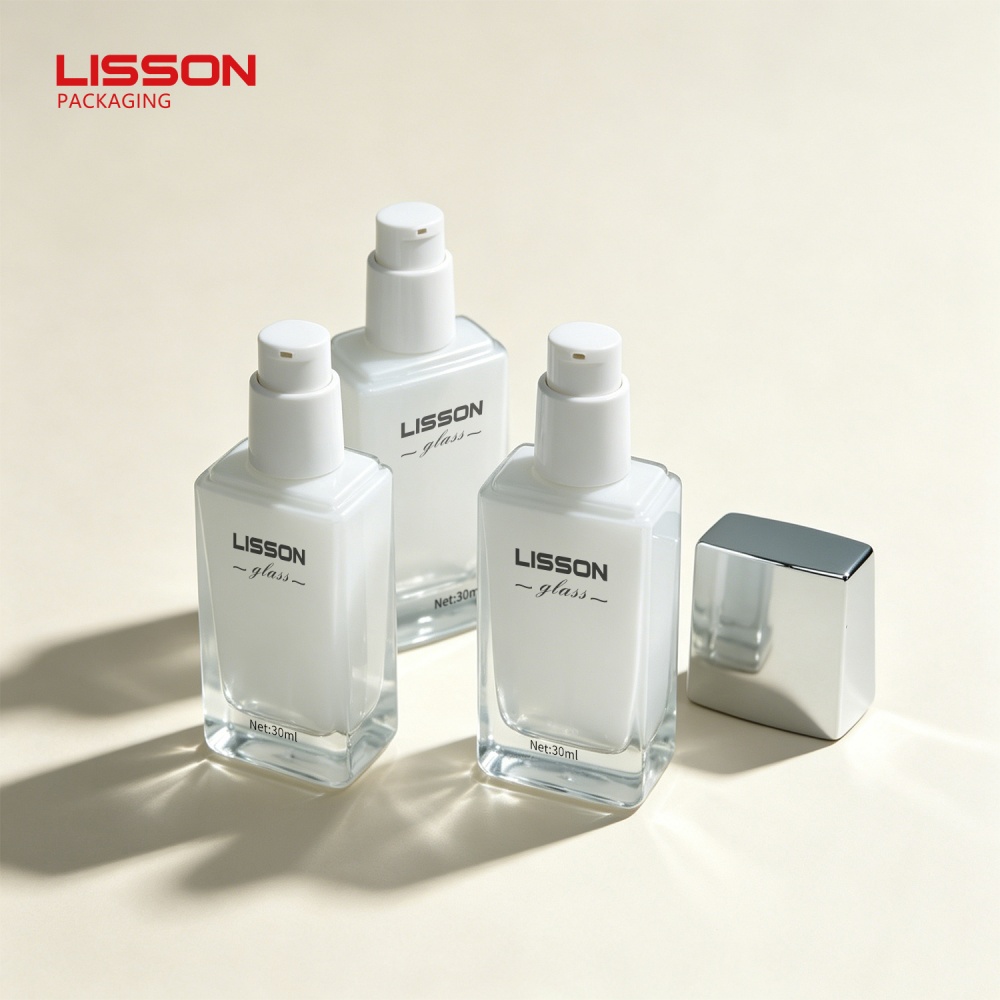
For example, LISSON's 30ml flat-square glass lotion bottle with an 18mm pump system is presented for liquid foundations, serums, and premium lotions. Its specifications make it a useful packaging option to evaluate, but the actual formula should still be tested before confirming suitability for a particular high-viscosity product.
Are Airless Pump Bottles Better for Thick Creams?
Airless packaging can be worth evaluating for certain skincare formulas, but it is not automatically the best solution for every thick cream. Performance depends on the specific dispensing mechanism, formula properties, and packaging configuration.
Traditional dip-tube pumps draw product upward through a tube. Airless systems use a different dispensing arrangement, often involving a piston or another mechanism that moves the product toward the outlet. Depending on the design, this can help reduce product exposure to air and improve product evacuation.
For high-viscosity formulas, brands should verify whether the airless mechanism can move the product consistently without excessive resistance, incomplete evacuation, or inconsistent doses.
Consider the following before choosing airless packaging:
- Whether the formula can move through the system at the intended temperature.
- Whether the dispensing mechanism is compatible with the formula's texture and composition.
- Whether the selected package delivers the desired amount per press.
- Whether the product can be dispensed consistently as the container empties.
- Whether the packaging materials are compatible with the formula over the intended shelf life.
Brands can explore LISSON's glass cosmetic packaging range when comparing packaging styles for skincare and cosmetic products. The final choice should be based on the actual dispensing requirements rather than the packaging type alone.
How Bottle Design and Dip Tube Length Affect Thick Formulas
The bottle and pump work as one dispensing system. Even a suitable pump can perform poorly if the bottle geometry or dip tube configuration prevents the formula from reaching the intake consistently.
A dip tube that is too short may leave a noticeable amount of product at the bottom. A tube that is too long or incorrectly positioned may bend, become obstructed, or interfere with the bottle base. The correct configuration depends on the internal dimensions of the bottle and the design of the pump.
Bottle geometry also matters. A container with a narrow shoulder or a shape that traps thick product away from the intake may make the final portion of the formula harder to dispense. For products that do not flow readily, testing the bottle's internal shape can be just as important as testing the pump.
When comparing packaging options, LISSON's 30ml round clear glass lotion bottle with gold cap offers another bottle-and-pump configuration to review. Check the specific product specifications and test the intended formula before selecting it for a thick lotion or cream.

How to Test Pump Performance Before Mass Production
Testing the actual formula and packaging combination before mass production helps identify dispensing issues before they affect a large quantity of finished products.
A practical validation process should include the following checks:
- Initial priming: Record how many full presses are required before the formula begins dispensing.
- Dose consistency: Measure the amount dispensed over repeated presses to identify variation.
- Actuation force: Check whether the pump can be operated comfortably and consistently.
- Leakage and closure integrity: Inspect the assembled package under appropriate storage and transport test conditions.
- Temperature performance: Evaluate dispensing at relevant temperatures if the formula's viscosity changes with temperature.
- Product evacuation: Assess how much formula remains in the bottle when normal dispensing becomes difficult.
- Formula compatibility: Confirm that the formula does not cause unacceptable changes to the pump or other packaging components during the planned storage period.
For B2B cosmetic brands, distributors, and private-label manufacturers, these checks help determine whether a dispensing issue comes from the formula, the pump, the bottle design, or the assembly process.
If a pump repeatedly fails with the intended formula, the supplier should review the test results and recommend a more suitable dispensing configuration rather than assuming that the same pump will work for every cosmetic product.
How Cosmetic Brands Can Prevent Thick Formula Pump Problems
Preventing pump problems begins during packaging development, not after the product reaches consumers. The formula and packaging should be assessed together before the final specification is approved.
- Share formula information early: Tell the packaging supplier whether the product is a lightweight lotion, dense cream, liquid foundation, or another high-viscosity formulation.
- Request technical specifications: Review pump output, compatible bottle dimensions, and available dispensing options.
- Test real samples: Evaluate the actual formula in the selected bottle and pump rather than relying only on water-based demonstrations.
- Check the full product lifecycle: Consider dispensing performance when the bottle is full, partially used, and nearly empty.
- Validate any component changes: Reassess compatibility if the formula, pump, bottle, or filling process changes.
For brands developing new skincare packaging, LISSON's customization service is a relevant starting point for discussing bottle appearance, branding, and packaging requirements. Provide the formula details and dispensing expectations so the proposed packaging can be assessed for the intended application.
The key principle is simple: a thick cosmetic formula needs a dispensing system that can handle its flow characteristics. Matching the pump, dip tube, and bottle—and validating them with the real formula—is the most reliable way to reduce clogging, slow dispensing, and inconsistent doses.
Frequently Asked Questions
Why does a thick cosmetic formula cause pump problems?
A thick formula resists flow, making it harder for the pump to draw product through the dip tube and move it through internal passages. If the pump is not suitable for the formula's viscosity, dispensing may become slow, inconsistent, or impossible.
Can thick lotion permanently damage a cosmetic pump?
Not necessarily. A thick lotion may simply be incompatible with the pump's dispensing capability. However, excessive force, repeated blockage, or formula residue can affect performance. Check the formula, pump specifications, and assembly before deciding whether replacement is necessary.
What type of pump is suitable for high-viscosity cosmetic formulas?
The suitable pump depends on the formula's viscosity, flow behavior, desired dose, and packaging dimensions. Ask the supplier for a pump designed for the intended product and validate its performance with the actual formula.
Are airless pump bottles suitable for thick creams?
Some airless systems may work well with selected thick creams, but suitability depends on the mechanism and formula. Test dispensing consistency, product evacuation, and compatibility before approving the package.
Why does a lotion pump work at room temperature but fail in cold conditions?
Some cosmetic formulas become more viscous at lower temperatures, which increases resistance to flow. If the product may be stored or transported in colder conditions, test the formula and pump at the relevant temperatures.
How can I reduce the amount of thick cream left inside a glass bottle?
Review the bottle's internal geometry, dip tube length and position, pump intake design, and formula flow behavior. Test the complete package to determine whether the remaining product can be reduced with a different configuration.
What should be tested before ordering glass lotion bottles in bulk?
Test initial priming, dose consistency, actuation force, leakage, formula compatibility, temperature performance where relevant, and product evacuation. Approve the actual bottle and pump combination before mass production.
Can LISSON provide glass cosmetic bottles for lotion and foundation products?
LISSON offers glass cosmetic packaging options, including glass lotion bottles with pump systems. Share the formula type, viscosity information, desired dispensing dose, bottle capacity, and customization requirements to help determine which packaging options should be evaluated.